Story
The Hollow Earth theory is one of the most fascinating alternative theories in history. According to this idea, Earth is not entirely composed of solid rock and metal layers but instead contains enormous internal cavities capable of supporting continents, oceans, and even advanced civilizations.
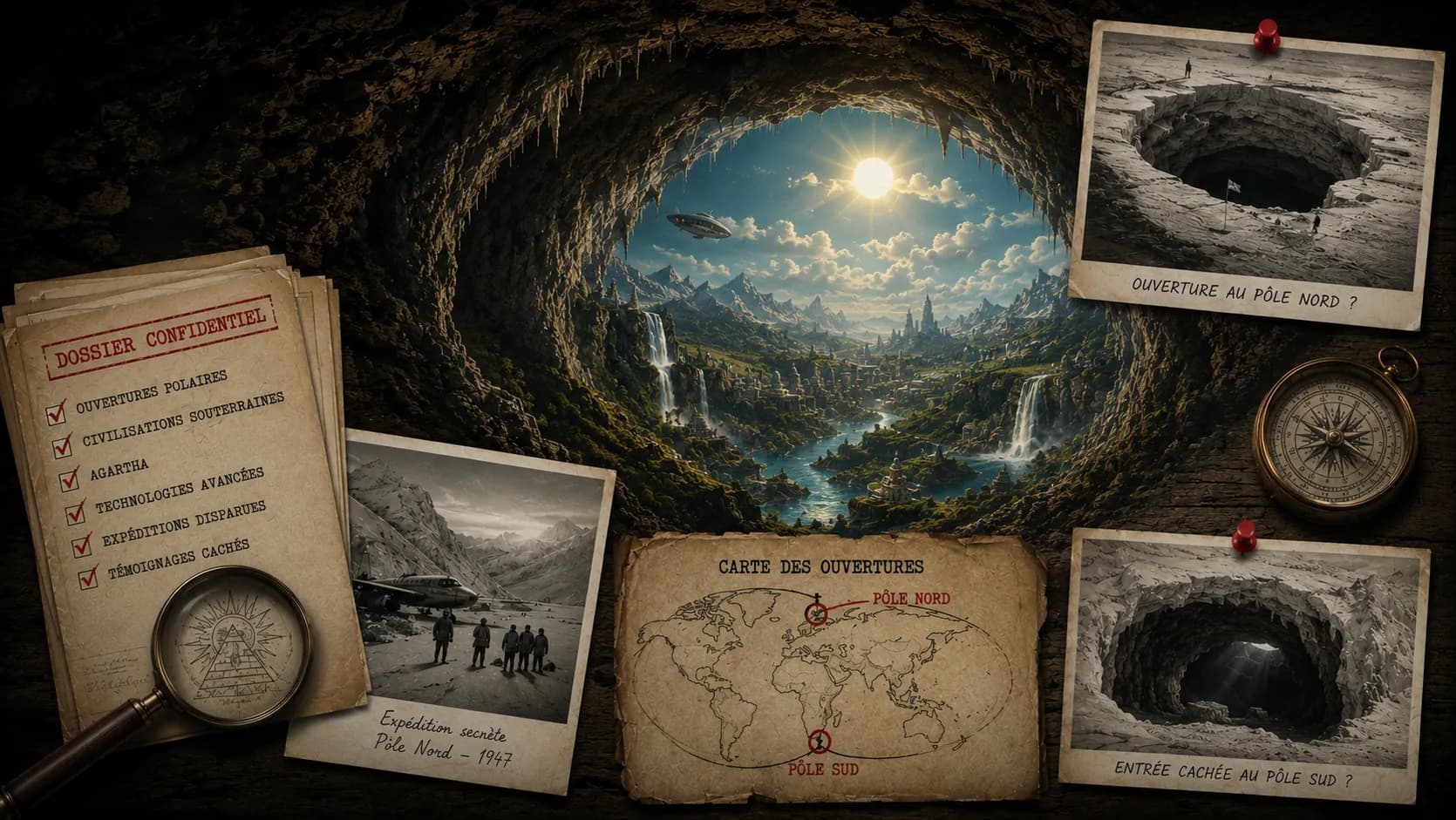
Supporters of the theory claim that giant openings exist at the North and South Poles, providing access to a hidden inner world. This underground realm is sometimes described as a technological paradise, while other stories speak of ancient peoples, giants, or unknown creatures.
Over the centuries, numerous expeditions have allegedly attempted to locate these secret entrances. Some legends even claim that explorers, military personnel, or scientists discovered evidence of this hidden world before it was concealed from the public.
Several versions of the theory exist. Some describe Earth as completely hollow with an internal sun. Others imagine a vast underground network of caverns inhabited by lost civilizations.
Hollow Earth is often connected to mythical locations such as Agartha and Shambhala, believed to be underground kingdoms inhabited by highly advanced beings.
Although modern geology strongly rejects the theory, it continues to fascinate mystery enthusiasts, science fiction fans, and followers of esoteric traditions.
Today, Hollow Earth remains one of the most iconic concepts in fantasy literature and conspiracy culture.
Credits and origin
The concept of Hollow Earth dates back to ancient times but gained a modern form during the 17th and 18th centuries when some scientists proposed theoretical models of hollow planets.
In the 19th century, American writer John Cleves Symmes Jr. strongly popularized the idea by claiming that Earth contained enormous polar openings.
The theory was later expanded through esoteric traditions, legends of Agartha, and speculation about hidden civilizations.
Main inspirations:
• Underground myths
• Agartha
• Shambhala
• Polar exploration
• Esotericism
• Science fiction
Origin: 17th–19th Century
Type: Alternative Theory
Main topic: Hidden underground world
Associated locations: Poles, Agartha, Shambhala
Popularity level: Very high
Popularization: Books, documentaries, novels, internet culture, and popular media